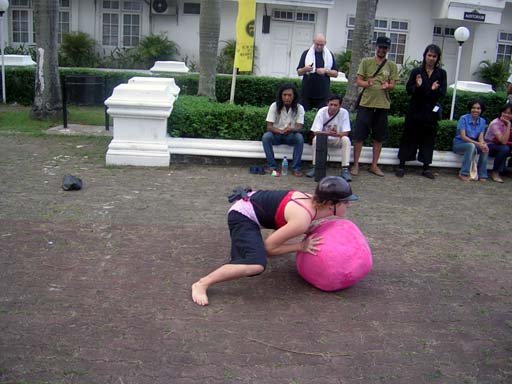
The Performance Klub in Yogyakarta holds a yearly performance art festival in the surrounding area of Yogyakarta. Last year, it took place in a small village in Bantul, commemorating the one-year anniversary of the devastating earthquake that rocked Yogyakarta in May, 2006. This year, the festival took place at Krinjing Village, high up in the mountains at the edge of Merapi, the volcano that towers over Yogyakarta and central Java. The theme, 'Global Warming, Global Warning', comes at a time when the active discussion of how to take charge of the health of our environment is essential to its survival for future generations. International artists and locals alike gathered together, participating in early-afternoon seminars regarding global warming and ways to save our  environment from complete destruction, and afternoon performances reflecting individual and group thoughts about the environment. Coming from a theater background, I'll admit that at times I find "performance art" to be boring- where's the excitement? Where's the beginning, middle and end? What really is performance, and how does performance art encompass that? This year's event was focused on group performance, forcing the typically solo performers to get into a group and collaborate. Ending results ranged, but I found for the most part the majority of performers to be working together but still separately, many of them doing individual actions in a shared space. The few that did work together included members of Taring Padi, who had audience members stick Salon Pas, heated patches, all over their bodies until they were full, yelling out "Panas!" ("Hot!"), "Body Warming!", and with help from the audience then taking those same patches and sticking them to a tree. This was a light-hearted way to link our own bodies to that of the earth, and brought enjoyment to participants all around. Another group, two performance artists from Surabaya and two from Kuala Lumpur, Malaysia, brought a large stack of tiny mirrors and handed them out to audience members. The audience then followed them up the hill and reflected the sun with their mirrors. This created an effective image, and brought direct
  relation between the audience members and the sun. On the last night of the festival, a group of thirty performers gathered together at midnight and climbed to the top of the volcano. This twelve-hour, strenuous climb was intense and not easy, a full hands-and-knees event, but once at the top for sunrise, it was stunning, and worth the scrapes and sore legs the following day. Global Warming, how many times do we have to say it's a reality? What is the most effective way to make people think twice about the way they consume, about what they burn and use for transportation? Is performance a good way to communicate these issues? Perhaps it is, and perhaps it isn't. The most important thing, I think, is gathering together as a community and making a true effort to discuss these issues, and take direct actions to address the way we treat our earth. Global Warming, Global Warning!!!
 environment from complete destruction, and afternoon performances reflecting individual and group thoughts about the environment. Coming from a theater background, I'll admit that at times I find "performance art" to be boring- where's the excitement? Where's the beginning, middle and end? What really is performance, and how does performance art encompass that? This year's event was focused on group performance, forcing the typically solo performers to get into a group and collaborate. Ending results ranged, but I found for the most part the majority of performers to be working together but still separately, many of them doing individual actions in a shared space. The few that did work together included members of Taring Padi, who had audience members stick Salon Pas, heated patches, all over their bodies until they were full, yelling out "Panas!" ("Hot!"), "Body Warming!", and with help from the audience then taking those same patches and sticking them to a tree. This was a light-hearted way to link our own bodies to that of the earth, and brought enjoyment to participants all around. Another group, two performance artists from Surabaya and two from Kuala Lumpur, Malaysia, brought a large stack of tiny mirrors and handed them out to audience members. The audience then followed them up the hill and reflected the sun with their mirrors. This created an effective image, and brought direct
  relation between the audience members and the sun. On the last night of the festival, a group of thirty performers gathered together at midnight and climbed to the top of the volcano. This twelve-hour, strenuous climb was intense and not easy, a full hands-and-knees event, but once at the top for sunrise, it was stunning, and worth the scrapes and sore legs the following day. Global Warming, how many times do we have to say it's a reality? What is the most effective way to make people think twice about the way they consume, about what they burn and use for transportation? Is performance a good way to communicate these issues? Perhaps it is, and perhaps it isn't. The most important thing, I think, is gathering together as a community and making a true effort to discuss these issues, and take direct actions to address the way we treat our earth. Global Warming, Global Warning!!!