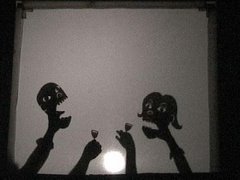
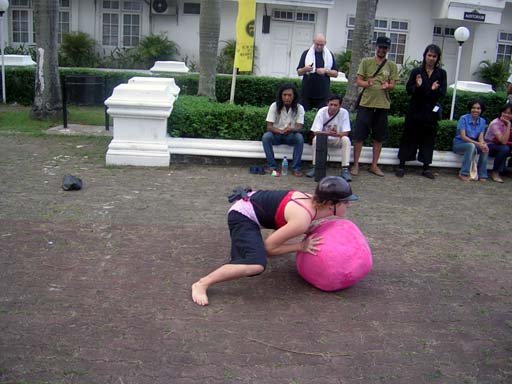
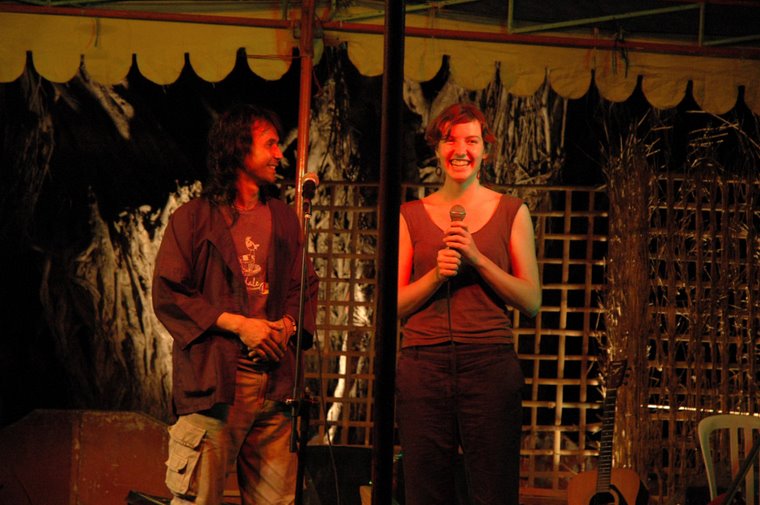
The last two days before our big collaboration performance at Lembaga Indonesia Perancis (French-Indonesian Cultural Center/LIP) was big work. No stage manager, very small budget, difficulty to come to an agreement... We worked two days nonstop from morning until night, preparing installations, figuring out how to position the projector and set the stage, choosing music,and most of all, trying to come to some kind of agreement on what we were going to do for the performance. I remember clearly the last hour before performance, when we were still taping down the screen  on our turned-around stage. By that time I was pretty exhausted, struggling with difficult double-tape and hungry. Talks of having some kind of structure had somehow started to move in the right direction, but still with loose ends and possible change at any time. When I look back on it, despite the difficulty and sometimes frustration, I like that our project was always changing and growing. We had no idea what would develop when we started. And we had to keep remembering that any expectations we might have had were not guaranteed to actually be used or develop into anything. It was a really good test on ego, which every artist needs sometimes I think.
We used the entire space at LIP, which I liked. In the garden in the beginning of the show, the audience could wander from performer to performer, who were each in their own individual worlds. I was at the sink, a collage of hundreds of women from sexy anorexic magazines behind me (you know the ones, think Cosmo, Lucky, all the others..), in my ugly teeth mask, big butt and all, trying to look pretty while at the same time bandaging all my toes and other wounds. Eventually over time all performers began to gather and move toward the gallery space, where Koni Herawati, one of the other artists, had created an installation of bamboo and hanging objects. There our individual characters began to emerge into one, we were walking in straight lines through the space (which was a long, narrow space), slowly removing our costumes and hanging them from the bamboo and hanging hooks throughout the space (no, this was not a strip tease and no, we were not naked). Eventually one by one we moved to the door by the auditorium, or theater space, in which the outline of each body was traced on the door before moving into the 'performance' space. In the auditorium, we had reversed the usual use of a stage, so that the audience sat on the open floor space, and we were positioned on the sitting area, which was a series of long stairs
  going up to the lighting box. On the stairs we had set up a long piece of white cloth, onto which was projected the image of a flowing river which Carrie Morris, another one of the artists, had recorded during our residency. We positioned ourselves on the stairs as if we were sleeping or lounging, no faces pointed directly toward the audience. Over a decent period of time, one by one our mumbling would slowly begin, until the mumbling grew louder and louder and eventually was drained out by the sound of the rushing water. The end. Lights out.
It's a good experience to participate in a collaboration, even if it's difficult. It's also a good experience to feel like you're already booked for a performance but still don't know exactly what you're doing, up to the hour before you're on. Somehow we pulled it off, and I think we managed to put on a pretty good, interesting, unique show. Don't ask me if I had it to do over whether I would agree to participate in the collaboration again. But I probably would. Why not? It was a good experience.

 on our turned-around stage. By that time I was pretty exhausted, struggling with difficult double-tape and hungry. Talks of having some kind of structure had somehow started to move in the right direction, but still with loose ends and possible change at any time. When I look back on it, despite the difficulty and sometimes frustration, I like that our project was always changing and growing. We had no idea what would develop when we started. And we had to keep remembering that any expectations we might have had were not guaranteed to actually be used or develop into anything. It was a really good test on ego, which every artist needs sometimes I think.
We used the entire space at LIP, which I liked. In the garden in the beginning of the show, the audience could wander from performer to performer, who were each in their own individual worlds. I was at the sink, a collage of hundreds of women from sexy anorexic magazines behind me (you know the ones, think Cosmo, Lucky, all the others..), in my ugly teeth mask, big butt
 and all, trying to look pretty while at the same time bandaging all my toes and other wounds. Eventually over time all performers began to gather and move toward the gallery space, where Koni Herawati, one of the other artists, had created an installation of bamboo and hanging objects. There our individual characters began to emerge into one, we were walking in straight lines through the space (which was a long, narrow space), slowly removing our costumes and hanging them from the bamboo and hanging hooks throughout the space (no, this was not a strip tease and no, we were not naked). Eventually one by one we moved to the door by the auditorium, or theater space, in which the outline of each body was traced on the door before moving into the 'performance' space. In the auditorium, we had reversed the usual use of a stage, so that the audience sat on the open floor space, and we were positioned on the sitting area, which was a series of long stairs
  going up to the lighting box. On the stairs we had set up a long piece of white cloth, onto which was projected the image of a flowing river which Carrie Morris, another one of the artists, had recorded during our residency. We positioned ourselves on the stairs as if we were sleeping or lounging, no faces pointed directly toward the audience. Over a decent period of time, one by one our mumbling would slowly begin, until the mumbling grew louder and louder and eventually was drained out by the sound of the rushing water. The end. Lights out.
It's a good experience to participate in a collaboration, even if it's difficult. It's also a good experience to feel like you're already booked for a performance but still don't know exactly what you're doing, up to the hour before you're on. Somehow we pulled it off, and I think we managed to put on a pretty good, interesting, unique show. Don't ask me if I had it to do over whether I would agree to participate in the collaboration again. But I probably would. Why not? It was a good experience.